

The Intentional Learning FrameworkTM

Mapping the whole journey an adult learner takes, from finding your course to finishing it, and shows what good design looks like at every step.
Get those steps right, and learners stay, engage, and actually finish.
Intentional design triggers intentional learning, at every stage
Most learning isn't lost to bad intentions. It's lost to design that happens by accident. Not every educator is a learning designer, yet most are asked to do design work that was never their core craft, with no time to do it. So we teach the way we were taught, we fill the gaps with best-effort guesswork, and good practice quietly fails to make it into the learning space.
My own doctoral research found that 100% of educators experience a gap between the practice they believe in and the practice they actually deliver.
The barrier is rarely will. It's time, workload, and a craft that shifts with every context, more than any one educator can be expected to hold. And often it's the system itself, built to manage learners rather than help teach them, that they work around rather than work with.
The Intentional Learning Framework closes that gap by making design deliberate at every stage. Intentional design leads to intentional engagement, intentional learning, and intentional outcomes.
When every step is designed with intention, engagement happens by design.
More than just teaching and content
Most professional development, and most learning design, fixes its gaze on Stage 4, the teaching and content, and Stage 5, the assessment, as though those were the only steps that count.
But by the time a learner reaches active learning, you have often already lost the ones who couldn't find your course, never quite started, or drifted off in the first week. Our Framework covers all six stages, because a learner can slip away at any of them, and most slip away long before the teaching begins.

Every stage has a purpose. And a way to get it right.
Intentional design begins with knowing exactly what each stage is for. Importantly, at every one, we've identified through research specific concrete changes that lift engagement and outcomes. For each stage below, you'll see its purpose, and a sample of what just one strategy can shift. Those changes, our strategies, are what I share with you.

1. Explore + Enrol
They find you, weigh it up, and decide it's worth their time. This is the decision phase, before any content is delivered, and it is where motivated applicants quietly fall away, often blocked by digital-skill barriers nobody designed for. We've observed sites that embrace intentional design at this stage see enrolments rise by 20 to 70%.

2. Welcome + Orient
They arrive, feel genuinely welcomed, and find their feet. The first messages after enrolment matter more than almost anything. It takes intentional design to orient a new learner to the space, the way things are done, and the support on offer, so they start ready rather than lost.

3. Roadmap + Expectations
They know where they're going, what's expected, and why it matters. A clear map of the content and expectations matters at the start of every unit, not just the course. Educator introductions that build trust, study guides that add value, and far less skipped content. Just one of our strategies here was observed to lift online content engagement from 33% to 77%.

4. Active Learning
They do the work, build the skills, and stay engaged. The stage most people picture as teaching. Here we unpack intentional active-learning design, why a mix of approaches beats any single one, why interaction is not the same as engagement, and how to build slides, videos and discussions that actually hold attention, while hosting classes where learners show up ready to participate. One of our strategies was observed to raise attendance from 29% to 87%, with 74% of learners having actively prepared for the session and 93% then actively participating.

5. Assessment + Feedback
They show what they can do, and learn from how they went. They show what they can do, and learn from how they went. What assessment is for, and what makes it good. Writing questions worth answering: one authentic rewrite using our approach lifted correct responses from 17% to 88%, same learners, same day, even though learners rated our rewrite as harder, not easier. Feedback that moves learning forward, with one of our strategies driving resubmissions down an average of 72% across nine sites. Plus, of course, addressing assessment in the era of generative AI.

6. Closure + Next Steps
They finish well, and know what comes next. The ending of a unit or a whole qualification, and the real work that belongs there: completion that lands, feedback worth capturing, transferring training into practice, and staying connected after the course ends.

I do the hands-on research, so you don't have to
This is not a model I sketched on a whiteboard over coffee one morning. The Intentional Learning Framework is built from hundreds of hours of empirical trials with educators and adult learners navigating real content over several years. This work goes through control groups and qualitative validation before anything ever becomes a strategy within our framework.
Those strategies are what I teach in PD On Demand, and what the Specification Papers encode for your systems. Here's what just a few of them can do:
Just one strategy raised first-unit completion from 53% to 84%. Another saw online lecture attendance triple, from 29% to 87%. And one of the simplest consistently shifted engagement with online content from 33% to 77% across nine sites.
See my peer-reviewed publications here.
A PD provider who is also an award-winning researcher?
That's a rare combination, and it's why the Framework rests on evidence rather than opinion.
I hold a PhD in online education and a Masters in L&D (online), and have taught online pedagogy at Bachelors level, and learning design at Masters level
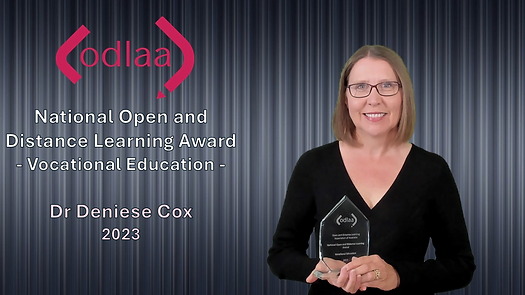
In addition to working as a university lecturer, I also have first-hand experience of being a VET trainer, and an L&D educator. This means that I know what it's like to juggle the competing demands of these roles, and I know what it's like to fight for the best outcomes for your learners.

Top rated presenter at NVC
Independently verified presenter rating of 4.8 / 5 across hundreds of participant reviews
Ways to put the Framework to work
The strategies are the substance of it.
You can learn them, or build them into your own system
Learn the strategies
Professional Development. PD On Demand turns the strategies from every stage of the Framework into an extensive library of short, practical video sets, ready to use straight away.
Work through them at your own pace, or roll them out across your team. Live sessions also available.
Book a call and we'll find the right fit.
Embed the strategies into your systems and your AI
Build it - the ILF for your systems and AI.
If you're building or choosing learning technology, everything behind the Framework is available in two ways:
-
ILF Specification Papers (build-ready) - Seven papers, 500+ pages, a decade of research your team and your AI build from directly.
-
Or use it live with AI (integration-ready) - Prefer to apply the Framework rather than build from it? ILF is also available inside compatible AI tools through the ILF-Powered MCP - direct access to its guidance and decision support, right where you work. Available now in early access.
Bring AI into your teaching or into your product?

The ILF Specification Papers make AI genuinely good for learning. That's one half. The other half is making your use of AI defensible, and that's where the wider Expert-Grounded AI (EGAI) initiative comes in, the work I do alongside Phill Bevan.
Through EGAI you can access:
-
The AI Adoption Specification Paper. A 100+ page expert reference that turns the tangle of privacy and education-sector obligations into plain answers, updated as regulations evolve.
-
The AI Adoption Intelligence Pack. Includes SKILL.md sets and structured instructions, prompts, decision rules and quality checks that translate that paper into something your AI agents, applications and build teams can act on directly.